- Zahnärzte Dres. Zimny & Kollegen
-
Uhlandstr. 53
10719 Berlin-Wilmersdorf - [email protected]
- 030 889 20 20 0

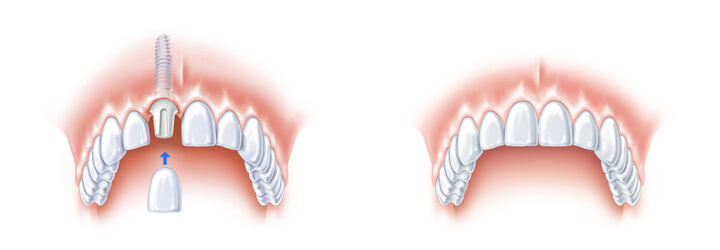
Auch wenn die Behandlungsmethode etwas aufwändiger ist, so bietet sie dem Patienten doch höchstmögliche Zufriedenheit. Zunächst erstellt der Zahnarzt ein dreidimensionales Röntgenbild, um die optimale Auswahl des eigentlichen Zahnimplantates anhand des – an der betreffenden Stelle – verfügbaren Knochens zu treffen.
Der zweite Schritt ist die Produktion einer genauen Schablone für die exakte Platzierung des Zahnimplantates im Knochen des Patienten.
Diese Arbeiten werden computerunterstützt und mit der Genauigkeit eines Hundertstelmillimeters durchgeführt. Danach wird der Knochen an der betreffenden Stelle vorsichtig aufgebohrt und das Zahnimplantat eingesetzt. Das geschieht, dank einer genau dosierten, örtlichen Betäubung, absolut schmerzfrei für den Patienten.
Nach einer Heilungsphase von drei bis fünf Monaten, die ein Provisorium überbrückt, wird die endgültige Krone auf der neuen Zahnwurzel befestigt und der Patient bekommt ein Tragegefühl, wie er es von seinen natürlichen Zähnen her kennt.
Insofern sind Zahnimplantate die optimale Wiederherstellung des natürlichen Zustandes, unabhängig ob als Einzelzahnersatz oder bei einem zahnlosen Kiefer. Darüber hinaus wirken Zahnimplantate dem Knochenschwund entgegen, der besonders in Regionen des Kiefers ohne aktive Zahnwurzel vorherrscht.
Wird das Zahnimplantat zusammen mit einer vollkeramischen Krone gemeinsam eingesetzt, ist das Ergebnis an Funktionalität, Festigkeit, Dauerhaftigkeit und Ästhetik nicht mehr zu übertreffen. Die Farbgebung der Krone wird den
umliegenden Zähnen angepasst, kein Metall kann das Zahnfleisch am Übergang zur Krone irritieren und der neue, künstliche Zahn wird seinem Träger wieder zu einem gewinnenden Lächeln verhelfen.
Mit schönen Zähnen fällt nicht nur ein positives Lächeln sehr viel leichter. Zähne sind ein wichtiger Bestandteil der Lebensqualität.
Die Ursachen für Zahnverlust sind sehr unterschiedlich:
Statistisch gesehen, gehen heutzutage mehr als 50% aller Zähne im Erwachsenenalter durch Parodontose verloren, zu einem früheren Zeitpunkt ist meistens Karies die Ursache.
Darüber hinaus gibt es auch Lücken durch Unfälle oder weil manche Zähne erst gar nicht gewachsen sind.

Je nach individueller Aufgabenstellung beim Patienten unterscheidet sich die Einzelzahnlücke von der Situation, dass mehrere Zähne fehlen (Schaltlücke oder Freiendsituation).
Daneben gibt es noch das reduzierte Restgebiss, bei dem die verbliebenen Zähne für einen Zahnersatz nicht mehr genug Halt bieten.
Wenn ein ganzer Kiefer zahnlos ist, kann mittels Zahnimplantaten eine Prothese sicher befestigt werden. Der wichtigste Vorteil eines Zahnimplantates besteht im Erhalt von
natürlichen Strukturen und bietet somit Schutz vor einem Knochenabbau.

Bei Patienten, die beispielsweise durch einen Unfall einen Frontzahn verloren haben, ersetzen wir diesen durch ein Zahnimplantat. Häufig müssen auch durch Karies oder Wurzelbehandlungen die unteren Backenzähne entfernt werden.
Vor allem bei gesunden Nachbarzähnen, die sonst für eine Brücke beschliffen werden müssten, sind Zahnimplantate sehr sinnvoll.
Auch größere Zahnlücken zwischen gesunden Zähnen können heute mit Zahnimplantaten versorgt werden. Dazu werden die Implantate an die Stelle der entfernten Zahnwurzeln gesetzt und später mit einer Brücke oder mit einzelnen Kronen vollendet.
Insbesondere bei Patienten, bei denen die Zähne endständig fehlen (Freiendsituation), also meist bei den hinteren Backenzähnen, empfehlen wir die Implantologie als Behandlungsmethode, damit ein herausnehmbarer Zahnersatz vermieden werden kann.
Bei einem reduzierten Restgebiss ist oft eine klassische Prothese nur als Kompromisslösung möglich. Durch Zahnimplantate kann man die notwendigen Pfeiler vermehren und so entweder einen festsitzenden Zahnersatz einsetzen oder einen herausnehmbaren viel graziler und komfortabler (bspw. ohne Gaumenplatte) gestalten.
Häufig kommen insbesondere ältere Patienten erst dann zu uns, wenn der Zahnersatz auch mit Haftcreme nicht mehr hält.
Diesem Zustand geht der starke Knochenabbau des Kiefers voraus.
In solchen Fällen wird durch das Setzen von Zahnimplantaten der Zahnersatz fest verankert.
Hierbei gibt es unterschiedliche Herangehensweisen: Wenn nur zwei Zahnimplantate gesetzt werden sollen oder das Knochenangebot bereits so reduziert ist, wird die Prothese auf zwei sogenannten Kugelknopfankern/Locator oder auf einem Steg fest verankert.
Sollten mehrere Implantate gesetzt werden können, so wird darauf eine zirkuläre Brücke fest zementiert oder aber auf Teleskope oder einen Steg gesetzt.
Dr. med. dent. Burghardt Zimny erläutert in einzelnen Kapiteln, wie komfortabel und nachhaltig der Zahnersatz mit Implantaten vom Spezialisten ist.
Videointerview Teil 1:
In welchen Fällen wird der Zahnersatz mit Implantaten empfohlen?
Videointerview Teil 2:
Welche Vorteile habenmoderne Implantate gegenüber Brücken und Kronen?
Videointerview Teil 3:
Wie ein Implantat angepasst wird und welche Rolle das Hightech Material Titan spielt
Videointerview Teil 4:
Schritt für Schritt: Wie wird ein Implantat eingesetzt und schließt die Lücke?
Videointerview Teil 5:
Eine nachhaltige Investition in Ihre Gesundheit. Implantate und ihre Lebenserwartung.
Zahnimplantate Zahnarzt Berlin Erklärung zur Barrierefreiheit
We firmly believe that the internet should be available and accessible to anyone, and are committed to providing a website that is accessible to the widest possible audience, regardless of circumstance and ability.
To fulfill this, we aim to adhere as strictly as possible to the World Wide Web Consortium’s (W3C) Web Content Accessibility Guidelines 2.1 (WCAG 2.1) at the AA level. These guidelines explain how to make web content accessible to people with a wide array of disabilities. Complying with those guidelines helps us ensure that the website is accessible to all people: blind people, people with motor impairments, visual impairment, cognitive disabilities, and more.
This website utilizes various technologies that are meant to make it as accessible as possible at all times. We utilize an accessibility interface that allows persons with specific disabilities to adjust the website’s UI (user interface) and design it to their personal needs.
Additionally, the website utilizes an AI-based application that runs in the background and optimizes its accessibility level constantly. This application remediates the website’s HTML, adapts Its functionality and behavior for screen-readers used by the blind users, and for keyboard functions used by individuals with motor impairments.
If you’ve found a malfunction or have ideas for improvement, we’ll be happy to hear from you. You can reach out to the website’s operators by using the following email
Our website implements the ARIA attributes (Accessible Rich Internet Applications) technique, alongside various different behavioral changes, to ensure blind users visiting with screen-readers are able to read, comprehend, and enjoy the website’s functions. As soon as a user with a screen-reader enters your site, they immediately receive a prompt to enter the Screen-Reader Profile so they can browse and operate your site effectively. Here’s how our website covers some of the most important screen-reader requirements, alongside console screenshots of code examples:
Screen-reader optimization: we run a background process that learns the website’s components from top to bottom, to ensure ongoing compliance even when updating the website. In this process, we provide screen-readers with meaningful data using the ARIA set of attributes. For example, we provide accurate form labels; descriptions for actionable icons (social media icons, search icons, cart icons, etc.); validation guidance for form inputs; element roles such as buttons, menus, modal dialogues (popups), and others. Additionally, the background process scans all the website’s images and provides an accurate and meaningful image-object-recognition-based description as an ALT (alternate text) tag for images that are not described. It will also extract texts that are embedded within the image, using an OCR (optical character recognition) technology. To turn on screen-reader adjustments at any time, users need only to press the Alt+1 keyboard combination. Screen-reader users also get automatic announcements to turn the Screen-reader mode on as soon as they enter the website.
These adjustments are compatible with all popular screen readers, including JAWS and NVDA.
Keyboard navigation optimization: The background process also adjusts the website’s HTML, and adds various behaviors using JavaScript code to make the website operable by the keyboard. This includes the ability to navigate the website using the Tab and Shift+Tab keys, operate dropdowns with the arrow keys, close them with Esc, trigger buttons and links using the Enter key, navigate between radio and checkbox elements using the arrow keys, and fill them in with the Spacebar or Enter key.Additionally, keyboard users will find quick-navigation and content-skip menus, available at any time by clicking Alt+1, or as the first elements of the site while navigating with the keyboard. The background process also handles triggered popups by moving the keyboard focus towards them as soon as they appear, and not allow the focus drift outside it.
Users can also use shortcuts such as “M” (menus), “H” (headings), “F” (forms), “B” (buttons), and “G” (graphics) to jump to specific elements.
We aim to support the widest array of browsers and assistive technologies as possible, so our users can choose the best fitting tools for them, with as few limitations as possible. Therefore, we have worked very hard to be able to support all major systems that comprise over 95% of the user market share including Google Chrome, Mozilla Firefox, Apple Safari, Opera and Microsoft Edge, JAWS and NVDA (screen readers).
Despite our very best efforts to allow anybody to adjust the website to their needs. There may still be pages or sections that are not fully accessible, are in the process of becoming accessible, or are lacking an adequate technological solution to make them accessible. Still, we are continually improving our accessibility, adding, updating and improving its options and features, and developing and adopting new technologies. All this is meant to reach the optimal level of accessibility, following technological advancements. For any assistance, please reach out to