- Zahnärzte Dres. Zimny & Kollegen
-
Uhlandstr. 53
10719 Berlin-Wilmersdorf - [email protected]
- 030 889 20 20 0

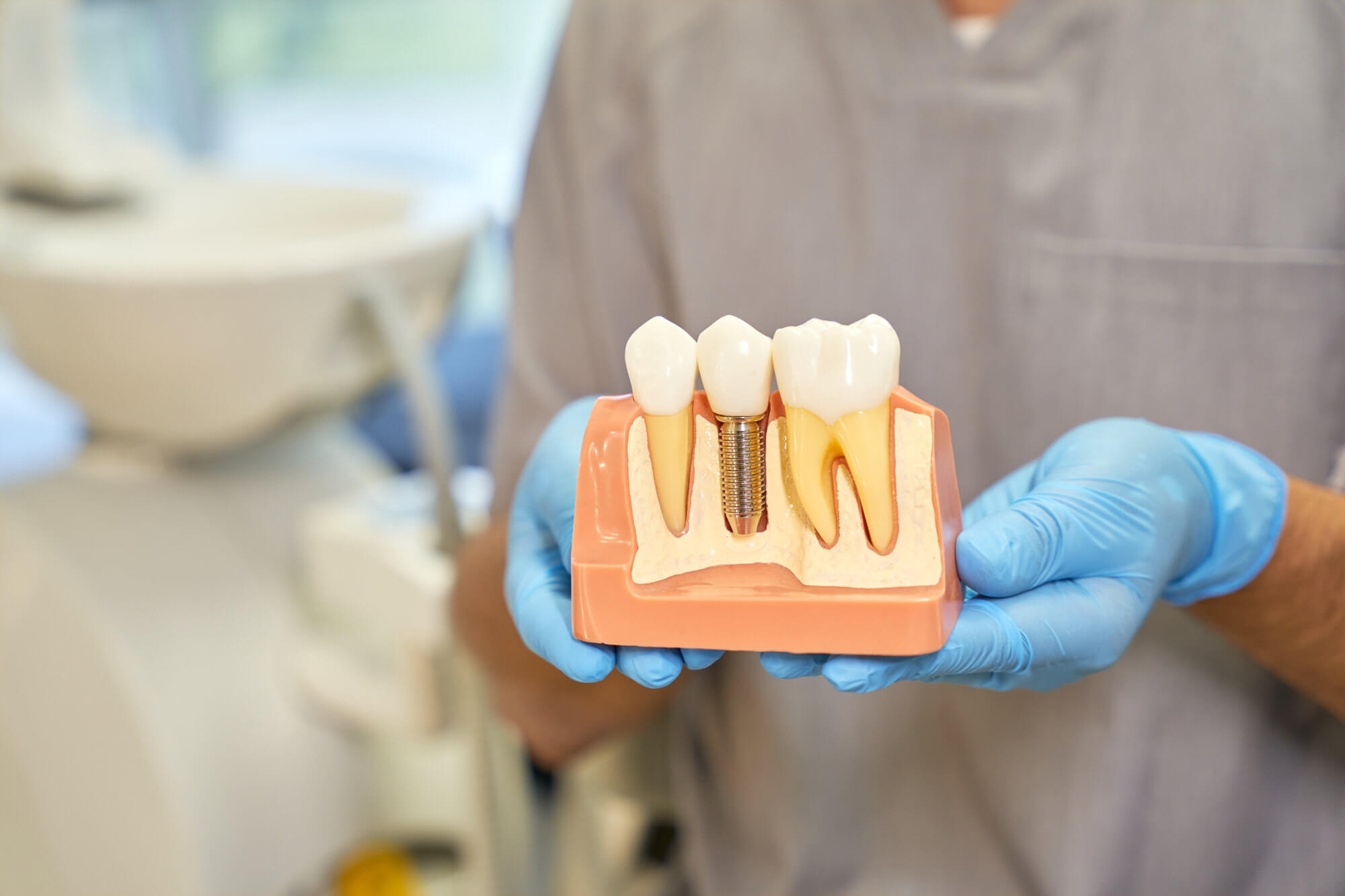


Das moderne, implantologische Behandlungskonzept All-In-Two wurde ursprünglich von Prof. Hürzeler erdacht und jetzt von Dr. Burghardt Zimny und seinem Laborteam weiterentwickelt.
Es bietet seinen Patienten erhebliche Zeitersparnis und deutlich weniger Therapietermine in der Praxis. Das bedeutet konkret, dass für die Behandlung mit All-in-Two nur zweimal ein Besuch notwendig ist und der Implantatpatient bereits nach dem zweiten Besuch über seinen vollständig wiederhergestellten Zahnersatz, also das Implantat und Krone verfügt.

Bei der konventionellen, implantologischen Behandlung wird zunächst das Implantat, also die kleine Schraube in den Kiefer eingesetzt. Nach diesem Behandlungsschritt wird eine kleine Abdeckschraube aufgesetzt und die Wunde vollständig vernäht. Während der Zeit, in der das Implantat in den Kiefer einwächst, bleibt eine Zahnlücke.
Im Normalfall ist für diesen Vorgang ein Zeitraum von drei Monaten nötig. Um die Abdeckschraube beim zweiten Termin wieder freizulegen wird ein kleiner Schnitt durchgeführt, das Schräubchen wird entfernt und gegen den sogenannten Zahnfleischformer ersetzt.
Dieser verweilt mindestens zwei Wochen im eingesetzten Implantat, bei Implantationen im Frontzahnbereich eher vier bis sechs Wochen. Erst nach dieser Zeit kann beim dritten Termin der Abdruck für die endgültige Zahnkrone gefertigt werden. Nach Abnahme des Abdrucks wird wieder der Zahnfleischformer aufgesetzt und verbleibt während der Fertigstellung der Zahnkrone im Labor weitere zwei Wochen im Implantat. Idealerweise wird beim vierten und letzten Termin die finale Krone mit dem eingesetzten Implantat zusammengeführt und bildet somit den endgültigen Zahnersatz.
Üblicherweise sind 4-5 Termine innerhalb von ca. fünf Monaten nötig, um ein perfektes Implantat auf konventionelle Weise im Kiefer zu verankern und mit einer Krone zu versorgen.
Das optimierte, implantologische All-In-Two Konzept ermöglicht es Dr. Zimny und seinem Team die Menge der Behandlungen und den dafür notwendigen Zeitraum erheblich zu reduzieren. Bereits bei der ersten Operation wird das Implantat in der perfekten Achse in den Kiefer eingesetzt. Dazu wird bei der Implantatplanung mittels dreidimensionalem Röntgengerät eine exakte Schablone hergestellt, die die optimale Operationsposition festlegt.
Direkt im Anschluss daran wird bereits die entsprechende digitale Basis hergestellt. Dazu wird anstelle von konventionellen Abdrücken ein modernes 3D Scannersystem zum Einsatz gebracht. Die daraus hergestellte Krone besteht nicht mehr wie bei konventionellen Implantaten aus zwei Elementen, sondern lediglich aus einer Komponente, die später direkt in das Implantat eingesetzt und von oben unsichtbar verschraubt wird.
Nach der Platzierung kann anders als beim konventionellen Implantat direkt ein nicht voll belastbares Provisorium eingesetzt werden. Die Einheilzeit in den Kiefer beträgt nach wie vor rund drei Monate. Beim folgenden Termin, bei dem auch das korrekte Anwachsen des Implantates an den Knochen geprüft wird, wird die im Vorfeld hergestellte Krone eingesetzt. Es ist nicht mehr nötig einen oder mehrere zusätzliche Termine zur Anpassung von Krone oder Zahnfleisch wahrzunehmen, denn bereits beim zweiten Termin ist der neue Zahnersatz komplett und voll einsatzfähig.
Im Vergleich zur herkömmlichen Vorgehensweise werden mindestens zwei Behandlungstermine und vier Wochen Behandlungszeit eingespart.
Durch unsere umfangreiche Erfahrung als Implantologen konnten wir das All-in-Two-Konzept von Prof. Hürzeler noch einmal entscheidend verbessern. Dabei entstand eine einzigartige Behandlungsmethode für zahnmedizinische Implantate, das lediglich zwei Schritten benötigt, schon vom ersten Tage an voll belastbar ist und an dessen Ende eine perfekte Zahnrekonstruktion steht.
Informieren Sie sich im Videointerview vom Praxisinhaber
Dr. med. dent. Burghardt Zimny über die Details:
Zahnimplantate Zahnarzt Berlin Erklärung zur Barrierefreiheit
We firmly believe that the internet should be available and accessible to anyone, and are committed to providing a website that is accessible to the widest possible audience, regardless of circumstance and ability.
To fulfill this, we aim to adhere as strictly as possible to the World Wide Web Consortium’s (W3C) Web Content Accessibility Guidelines 2.1 (WCAG 2.1) at the AA level. These guidelines explain how to make web content accessible to people with a wide array of disabilities. Complying with those guidelines helps us ensure that the website is accessible to all people: blind people, people with motor impairments, visual impairment, cognitive disabilities, and more.
This website utilizes various technologies that are meant to make it as accessible as possible at all times. We utilize an accessibility interface that allows persons with specific disabilities to adjust the website’s UI (user interface) and design it to their personal needs.
Additionally, the website utilizes an AI-based application that runs in the background and optimizes its accessibility level constantly. This application remediates the website’s HTML, adapts Its functionality and behavior for screen-readers used by the blind users, and for keyboard functions used by individuals with motor impairments.
If you’ve found a malfunction or have ideas for improvement, we’ll be happy to hear from you. You can reach out to the website’s operators by using the following email
Our website implements the ARIA attributes (Accessible Rich Internet Applications) technique, alongside various different behavioral changes, to ensure blind users visiting with screen-readers are able to read, comprehend, and enjoy the website’s functions. As soon as a user with a screen-reader enters your site, they immediately receive a prompt to enter the Screen-Reader Profile so they can browse and operate your site effectively. Here’s how our website covers some of the most important screen-reader requirements, alongside console screenshots of code examples:
Screen-reader optimization: we run a background process that learns the website’s components from top to bottom, to ensure ongoing compliance even when updating the website. In this process, we provide screen-readers with meaningful data using the ARIA set of attributes. For example, we provide accurate form labels; descriptions for actionable icons (social media icons, search icons, cart icons, etc.); validation guidance for form inputs; element roles such as buttons, menus, modal dialogues (popups), and others. Additionally, the background process scans all the website’s images and provides an accurate and meaningful image-object-recognition-based description as an ALT (alternate text) tag for images that are not described. It will also extract texts that are embedded within the image, using an OCR (optical character recognition) technology. To turn on screen-reader adjustments at any time, users need only to press the Alt+1 keyboard combination. Screen-reader users also get automatic announcements to turn the Screen-reader mode on as soon as they enter the website.
These adjustments are compatible with all popular screen readers, including JAWS and NVDA.
Keyboard navigation optimization: The background process also adjusts the website’s HTML, and adds various behaviors using JavaScript code to make the website operable by the keyboard. This includes the ability to navigate the website using the Tab and Shift+Tab keys, operate dropdowns with the arrow keys, close them with Esc, trigger buttons and links using the Enter key, navigate between radio and checkbox elements using the arrow keys, and fill them in with the Spacebar or Enter key.Additionally, keyboard users will find quick-navigation and content-skip menus, available at any time by clicking Alt+1, or as the first elements of the site while navigating with the keyboard. The background process also handles triggered popups by moving the keyboard focus towards them as soon as they appear, and not allow the focus drift outside it.
Users can also use shortcuts such as “M” (menus), “H” (headings), “F” (forms), “B” (buttons), and “G” (graphics) to jump to specific elements.
We aim to support the widest array of browsers and assistive technologies as possible, so our users can choose the best fitting tools for them, with as few limitations as possible. Therefore, we have worked very hard to be able to support all major systems that comprise over 95% of the user market share including Google Chrome, Mozilla Firefox, Apple Safari, Opera and Microsoft Edge, JAWS and NVDA (screen readers).
Despite our very best efforts to allow anybody to adjust the website to their needs. There may still be pages or sections that are not fully accessible, are in the process of becoming accessible, or are lacking an adequate technological solution to make them accessible. Still, we are continually improving our accessibility, adding, updating and improving its options and features, and developing and adopting new technologies. All this is meant to reach the optimal level of accessibility, following technological advancements. For any assistance, please reach out to